The concept of choosing -element subsets from a set is captured by the notation . Here, can be any collection of distinct objects, and is a non-negative integer. We define
which collects all subsets of containing exactly elements.
This notation generalizes the familiar binomial coefficient when is finite; for , we recover the number of -element subsets, often written as . In this abstract form, we focus on the subsets themselves rather than just their count.
Understanding is essential for defining the edges of an undirected graph, since edges are unordered pairs of vertices. The set will serve as the universe from which graph edges are drawn.
Let and . Then
Choosing friends for a team from your class of students is like forming every possible group of size — that’s exactly what represents.
Graph Definition (Undirected)
An undirected graph is specified by a pair , where is an arbitrary set of and
is a collection of , each edge being a two-element subset of .
Vertices serve as the fundamental units or points in the graph, and edges connect pairs of vertices without any inherent direction. By restricting to subsets of size 2, we ensure that loops and multiple edges are excluded in this simple graph model.
This framework provides a versatile way to model relationships in networks, social connections, or any system of pairwise interactions.
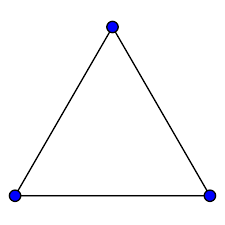
A triangle graph has and
Think of vertices as towns and edges as bidirectional roads connecting them.
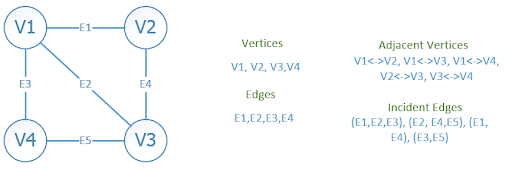
Adjacency and Incidence
Two vertices are called if the edge belongs to . In symbolic form,
An edge is said to be to its two endpoints and . Incidence describes the relationship between an edge and each vertex it connects.
Understanding adjacency and incidence is crucial for exploring paths, connectivity, and other graph-theoretic properties.
In the triangle graph above, and are adjacent since , and the edge is incident to both and .
If vertices are people, adjacency is like two people shaking hands; the handshake (edge) is incident to both participants.
Order and Size
The of a graph , denoted , is the number of vertices:
The of , denoted , is the number of edges:
Order and size quantify the basic scale of a graph and are fundamental parameters in graph analysis, impacting complexity and connectivity.
A triangle graph has order and size .
In a road network, order is the number of cities, and size is the number of roads.
Degree of a Vertex
The in a graph represents an entity or node within the structure. Each can be connected to other vertices via .
The of a vertex , denoted or , counts how many are incident to . It quantifies the immediate connectivity of within the graph.
When a specific graph is clear from context, we often write instead of for brevity. This notation streamlines discussions when only one graph is under consideration.
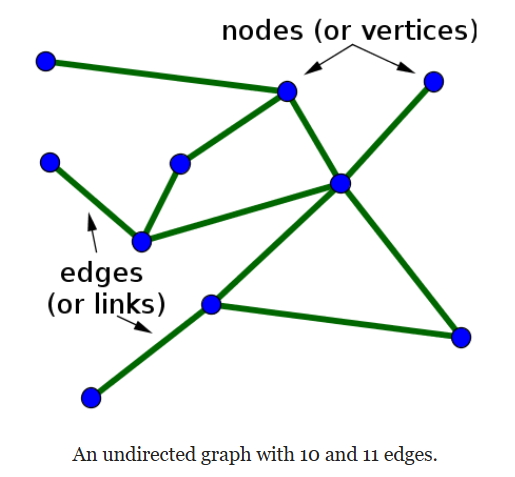
Figure 1. Degrees of vertices in a graph
Understanding is fundamental for analyzing graphs, as it appears in many algorithms for traversals, connectivity checks, and network analysis.
In a triangle graph with vertices and edges , each vertex has .
The of a is like counting how many roads enter an intersection in a road network.
Special Vertices: Isolated Vertex and Leaf
A whose is is called an . It has no connecting it to any other .
An stands completely alone in the graph, making it a candidate for special handling in algorithms that ignore unreachable components.
A with is known as a . It connects to exactly one other via a single .
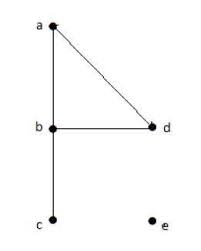
Figure 2. Isolated vertex (e) and leaf (c).
In a graph with vertices and edges , is an , while and are both .
An is like a remote cabin with no roads leading to it, and a is like a dead-end street connecting to only one other road.
Neighborhood of a Vertex
The of a is the set of all vertices directly connected to by an .
Formally, , where is the set of all in graph . It captures the immediate adjacency of .
Analyzing is crucial for exploring local properties of graphs, such as local clustering, degree-based centrality, and BFS expansions.
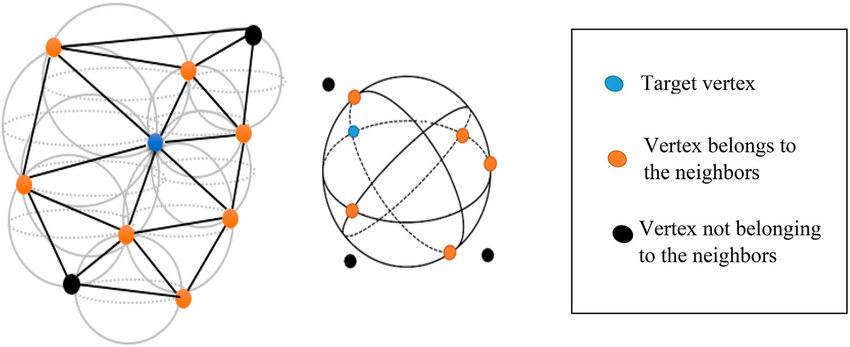
Figure 3. Neighborhood of a vertex.
In the same graph with edges , the of is .
The of a is like a person’s friend list in a social network, listing everyone they are directly connected to.
Conclusion
This excerpt establishes the foundational definitions of simple undirected graphs.
We introduced the notation for -element subsets, defined a graph with vertices and edges, and clarified the notions of adjacency and incidence.
We saw how the order and size measure a graph’s scale, setting the stage for deeper exploration of graph-theoretic concepts.
We defined the of a as the number of incident to it, using the notation or to quantify connectivity.
Special cases arise when the is , yielding an , or , yielding a , each requiring distinct considerations in graph algorithms.
The collects all vertices adjacent to , providing a foundation for local analysis, traversal techniques, and measures of influence within networks.
.png)