Isomorphism
Definition of Graph Isomorphism
Two graphs
In other words, although the vertex labels may differ, the connectivity pattern is the same. Isomorphism captures the idea that
Studying isomorphic graphs allows us to classify graphs by their underlying structure, ignoring superficial differences in labeling or drawing style.
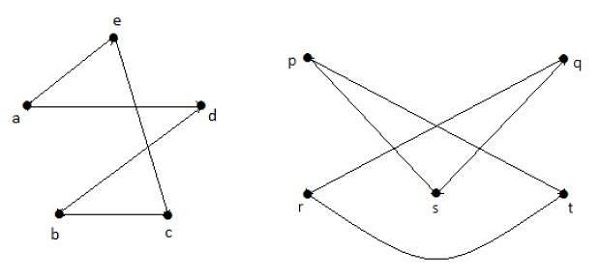
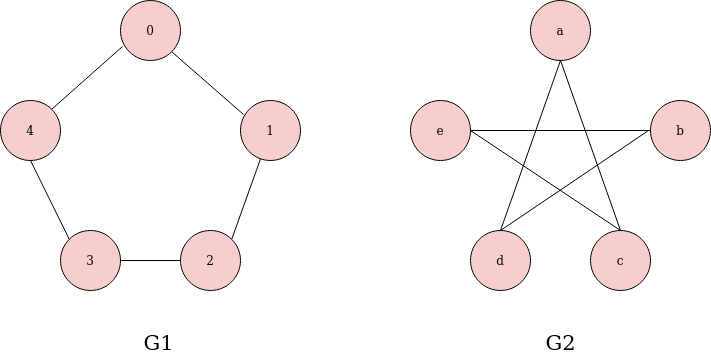
Figure 1. Isomorphic graphs.
Consider two triangles: one with vertices labeled
Graph isomorphism is like having two jigsaw puzzles with different artwork on the pieces but the same shapes—they fit together in exactly the same way.
Bijection and Edge Preservation
The core of graph isomorphism is a
This means for any two vertices
Thus, if
Edge preservation guarantees that the bijection does not create or destroy connections, maintaining the exact adjacency relationships between vertices.
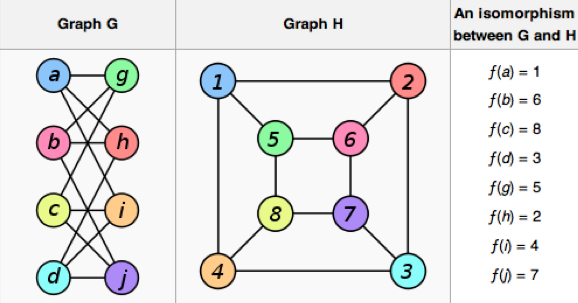
Figure 2. Isomorphic graphs with different vertex labels.
If
A bijection preserving edges is like renaming streets on a map—every intersection and road remains the same, only the names change.
Notation and Equivalence
We denote graph isomorphism by
This symbol indicates that
Indeed,
- Reflexivity: every graph is isomorphic to itself via the identity map.
- Symmetry: if
via , then via . - Transitivity: if
and , then by composing bijections.
If
Treating isomorphic graphs as equivalent is like considering two languages interchangeable if there is a perfect translation both ways—meaning anything said in one can be faithfully conveyed in the other.
Conclusion
Graph isomorphism identifies when two graphs share the same structure up to relabeling of vertices. It relies on a bijection that preserves adjacency exactly. The notation