Graph classes
Null Graph
A is the simplest possible with an empty .
Since there are no , there can be no , making it both - and -empty.
Despite its triviality, the serves as a base case in many inductive arguments and definitions in graph theory.
It highlights that a need not contain any elements to still qualify as a valid structure.
The graph with and is a .
A is like an empty stage before any actors or props arrive.
Complete Graph
A , or , of order has every possible connection between its .
Formally, , meaning each pair of distinct is joined by an .
exemplifies maximum connectivity and appears in extremal graph theory and Ramsey theory.
It represents the most "dense" simple on .
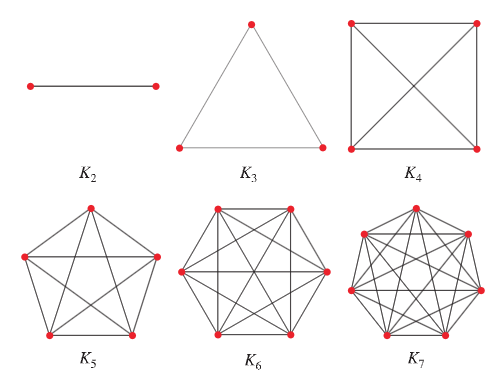
Figure 1. Complete graph with different numbers of vertices.
has 4 and 6 , connecting every pair.
A is like a roundtable meeting where every participant shakes hands with every other.
Graph Complement
The of a flips connections: it has the same but includes exactly those not in .
Formally, and
Thus and together partition the complete on the same vertices into complementary edge sets.
Graph complements reveal hidden structure and appear in characterizations of self-complementary graphs.
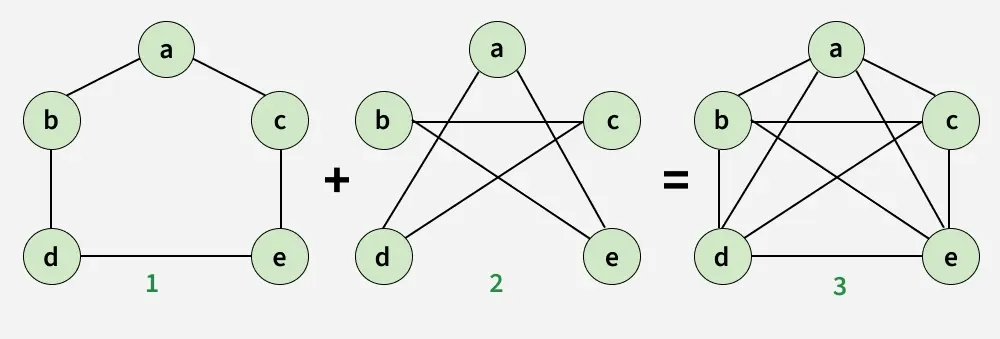
Figure 2. Graph complement. If we add the edges of 1st graph to the 2nd, we get a complete graph (3).
If is on vertices with edges , then has the single edge .
Taking the complement is like swapping every handshake in a room for every missed handshake instead.
Empty Graph
An , or , of order has all but no .
Formally, , highlighting its complete lack of connections.
represents the sparsest nontrivial simple on .
It contrasts with by maximizing isolation rather than connectivity.
Null Graph vs. Empty Graph
The null graph has and , while the empty graph but .
has 3 and 0 .
An is like three people standing in a room who do not speak or interact at all.
Conclusion
We have examined four fundamental classes: the (empty vertices), the (all edges), the (no edges), and the (edge inversion).
These classes serve as benchmarks for extremal connectivity and isolation, and the complement operation provides a dual perspective on any simple .
Understanding these builds a foundation for deeper graph-theoretic investigations and applications.