Connectivity
Definition of Connectivity
A graph is one in which for every pair of its there exists a connecting them.
If no such exists for some pair, the graph is .
A of a graph is a maximal — you cannot add any other vertex or edge from the original graph without breaking connectivity.
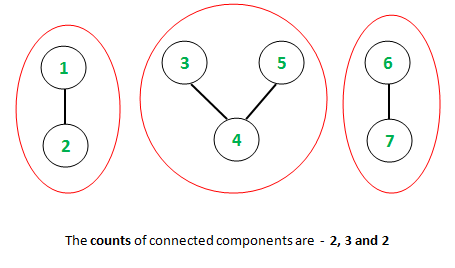
Figure 0. Connected components of a graph.
The vertex sets of all form a partition of , meaning each vertex belongs to exactly one component.
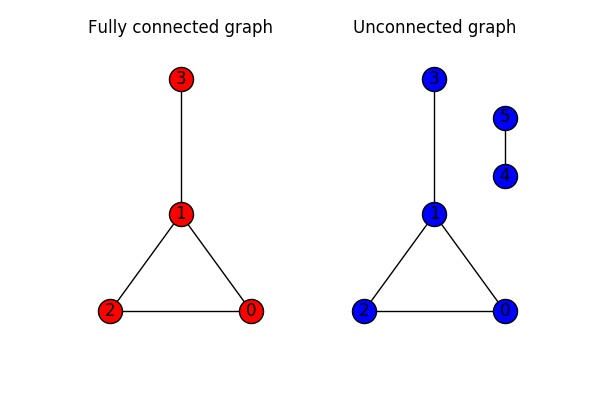
Figure 1. Connected and disconnected graphs.
Consider a social network graph split into two groups with no friendships between them; each group is a and the entire graph is .
A is like an isolated island of people who all know each other, with no bridges to other islands.
Forests and Trees
A is an graph — there are no in any of its .
Each of a is called a .
A fundamental property is that any of order (having ) has exactly .
Important Property of Trees
where is the number of edges and is the number of vertices in a tree .
This property holds for all trees, regardless of their structure or size.
This property underlies many algorithms, such as constructing minimum spanning trees and organizing hierarchical data.
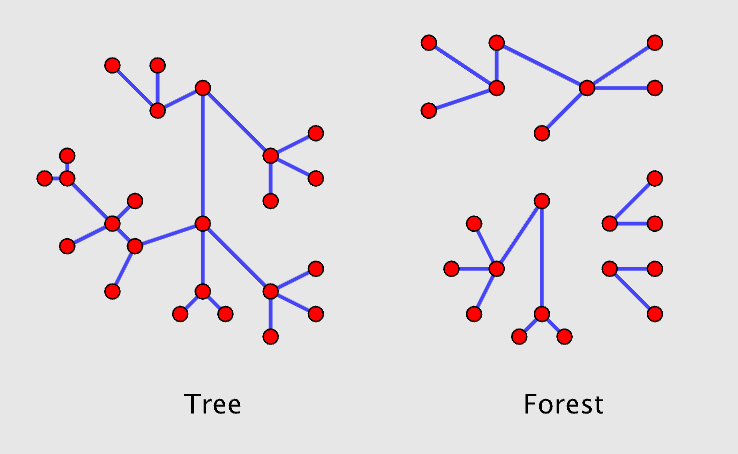
Figure 2. Trees and forests.
A corporate hierarchy chart with no circular reporting lines is a , and each department’s chart is a with one fewer reporting line than members.
A is like a grove of family trees, each spreading branches without ever looping back.
Conclusion
We have defined graphs and their maximal , noting that vertex sets of components partition the graph.
We then introduced — graphs without — and explained that each component of a forest is a with exactly one fewer edge than vertices.
These concepts of connectivity and acyclicity form the backbone of many graph-theoretic algorithms and real-world network models.