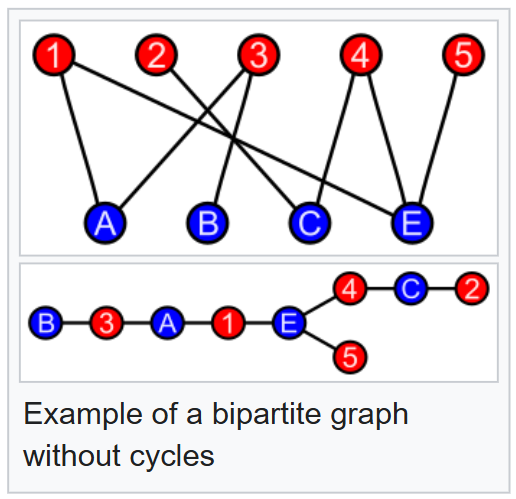
A is one whose can be partitioned into two subsets and so that every joins a vertex in to a vertex in .
Equivalently, the induced subgraphs and contain no , making them empty graphs on their respective vertex sets.
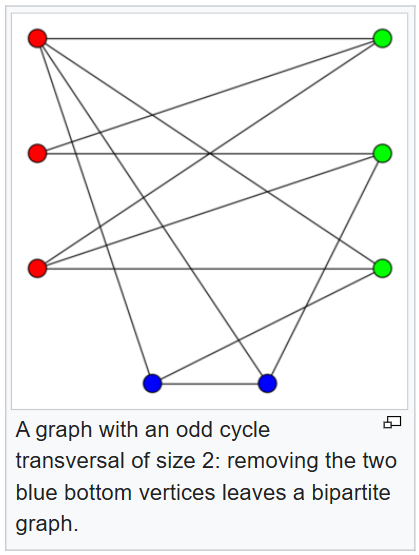
This structure prohibits any from existing, since an odd cycle would force an edge within one part when you alternate back to the start.
The graph with , and edges is bipartite because every edge connects to .
Think of two islands and connected only by bridges; no bridge ever connects points on the same island.
Characterization by Odd Cycles
A fundamental states that a graph is if and only if it contains no .
If an odd cycle existed, alternating vertices would land two consecutive vertices in the same part, contradicting the bipartition.
Conversely, if no odd cycle is present, one can color vertices by distance parity from an arbitrary root, yielding a valid bipartition.
This criterion provides both a theoretical test and a practical BFS coloring algorithm for detecting bipartiteness.
The cycle is bipartite (no odd cycle), while fails the test due to its length .
It’s like checking whether you can two-color every step of a dance floor without stumbling back onto your own color in an odd number of moves.
Complete Bipartite Graphs
Recall
A complete graph is one where every pair of distinct vertices is connected by an edge.
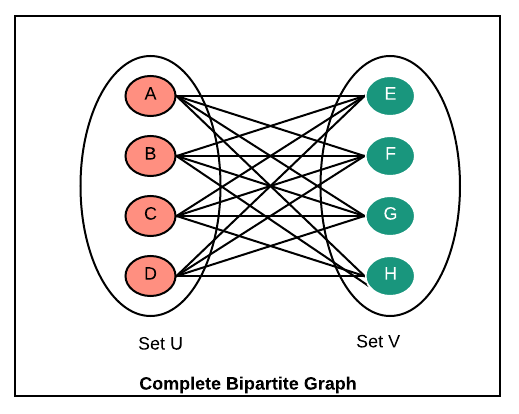
A has parts with , , and contains every possible between and .
Such a graph maximizes connectivity across parts while maintaining zero connectivity within each part, yielding edges.
Complete bipartite graphs serve as extremal examples and appear in matching theory and network design.
connects every one of the 2 vertices in to all 3 in , totaling edges.
Imagine a job fair where every of the recruiters meets every of the candidates, and no two recruiters or candidates meet amongst themselves.
Isomorphism of and
Two complete bipartite graphs and are isomorphic exactly when their part sizes match as sets, i.e., .
This means either and , or and , capturing the symmetry of swapping the two parts.
No other relabeling can equate them, since the degree multiset uniquely identifies the part sizes.
but neither is isomorphic to .
It’s like two rectangular grids: a grid can be turned into a grid by rotation, but not into a one.
Induced Subgraphs Remain Bipartite
Any induced subgraph of a inherits the original partition restricted to the selected vertices.
Since no within a part existed originally, none can appear in the induced subgraph.
Thus bipartiteness is preserved under vertex deletion.
Removing one vertex from yields a bipartite subgraph with parts sizes .
It’s like removing some bridges between two islands—you still have two islands with no internal bridges.
Complete Bipartite Graphs Which Are Trees
A tree is an acyclic connected graph. For to be a tree, it must have edges and no cycles.
Since a tree on vertices has exactly edges, we require .
Solving yields , so giving .
Hence only (a single edge) and (a path of length 2) are complete bipartite trees.
is just an edge, is a 3-vertex path, both trees.
Imagine two stations connected by all possible rails: only trivial rail lines avoid forming loops.
Regular Bipartite Graphs Have Equal Part Sizes
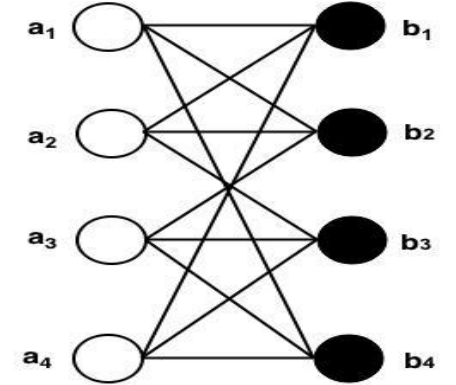
Let be a -regular with parts and . Each vertex in has neighbors in , contributing cross-edges.
Similarly, vertices in contribute cross-edges. Counting the same edges twice gives .
Since , we conclude .
A -regular bipartite graph must have the same number of vertices on each side, e.g. and both of size 4.
If every dancer on one side has exactly partners on the other, both sides must have equal headcounts to match the partnerships.
Conclusion
Bipartite graphs split vertices into two independent parts with no internal edges and avoid , ensuring two-colorability.
Complete bipartite graphs maximize cross-part connections, are isomorphic precisely when match, and reduce to simple trees only in trivial small cases.
Induced subgraphs of bipartite graphs remain bipartite, and regular bipartite graphs enforce equal part sizes, demonstrating the rich interplay of combinatorial counting and structural constraints in this class of graphs.