Projections
When we working with constrained optimization problems, the concept of projection plays a crucial role. It helps us find the closest point in a convex set to a given point outside the set.
The projection of a point onto a convex set is a fundamental concept in constrained optimization and mathematical analysis. It represents the closest point in a convex set to a given point outside the set.
Definition
Given a convex set
This means that
In simpler terms:
- If
is outside the convex set , the projection is the nearest point on the boundary of . - If
is inside the convex set, then the projection is simply .
Properties of Projection
Let
1. Non-expansiveness
The projection operator is non-expansive, meaning that it does not increase distances:
This ensures that the projection does not introduce additional stretching or distortion.
2. Idempotency
Applying the projection twice does not change the result:
This means that once a point is projected onto the set, projecting it again does nothing — it remains in place.
3. Optimality Condition
The projection
This condition ensures that the difference vector
Visual Understanding
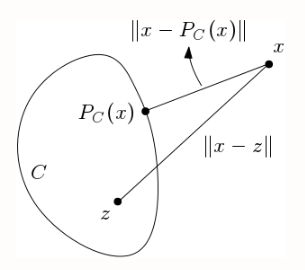
Here the distance between
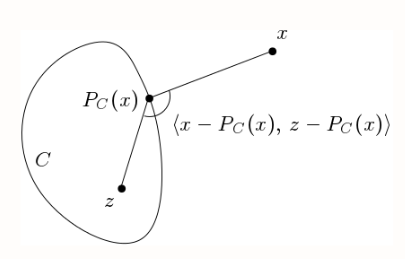
Here the inner product condition confirms that the projection direction is perpendicular to the tangent at
This stuff:
Just a different way to write it 🤷♀️
These visualizations emphasize that projection always follows the shortest path to the set.
Summary
| Property | Formula | Interpretation |
|---|---|---|
| Projection definition | Finds the closest point in |
|
| Non-expansiveness | Projection does not increase distances. | |
| Idempotency | Repeated projections do not change the point. | |
| Optimality condition | Projection direction is orthogonal to the boundary at |