Lipschitz Functions
We've explored smooth functions that change gradually without steep fluctuations. Now, let's dive into Lipschitz functions, which are kinda similar but have a different twist.
A Lipschitz function is a function whose rate of change is bounded, meaning it does not grow too rapidly. This property is essential in optimization and analysis because it ensures that small changes in input do not lead to arbitrarily large changes in output.
Lipschitz continuity is a generalization of smoothness but does not require differentiability. This makes it useful for studying functions that may have sharp corners or discontinuous derivatives.
Definition
Let
-
is -Lipschitz, meaning: This means that the function does not change too quickly — its maximum rate of change is controlled by
. -
The gradient of
is bounded in spectral norm: This condition means that the norm of the Jacobian (or the gradient in scalar functions) is upper-bounded by
, ensuring that does not have steep gradients.
This theorem provides a useful connection between function values and its differentials — if one is bounded, so is the other.
This condition ensures that the function does not change too abruptly — its growth is limited by the constant
- If
is small, the function changes slowly. - If
is large, the function can vary significantly but is still bounded.
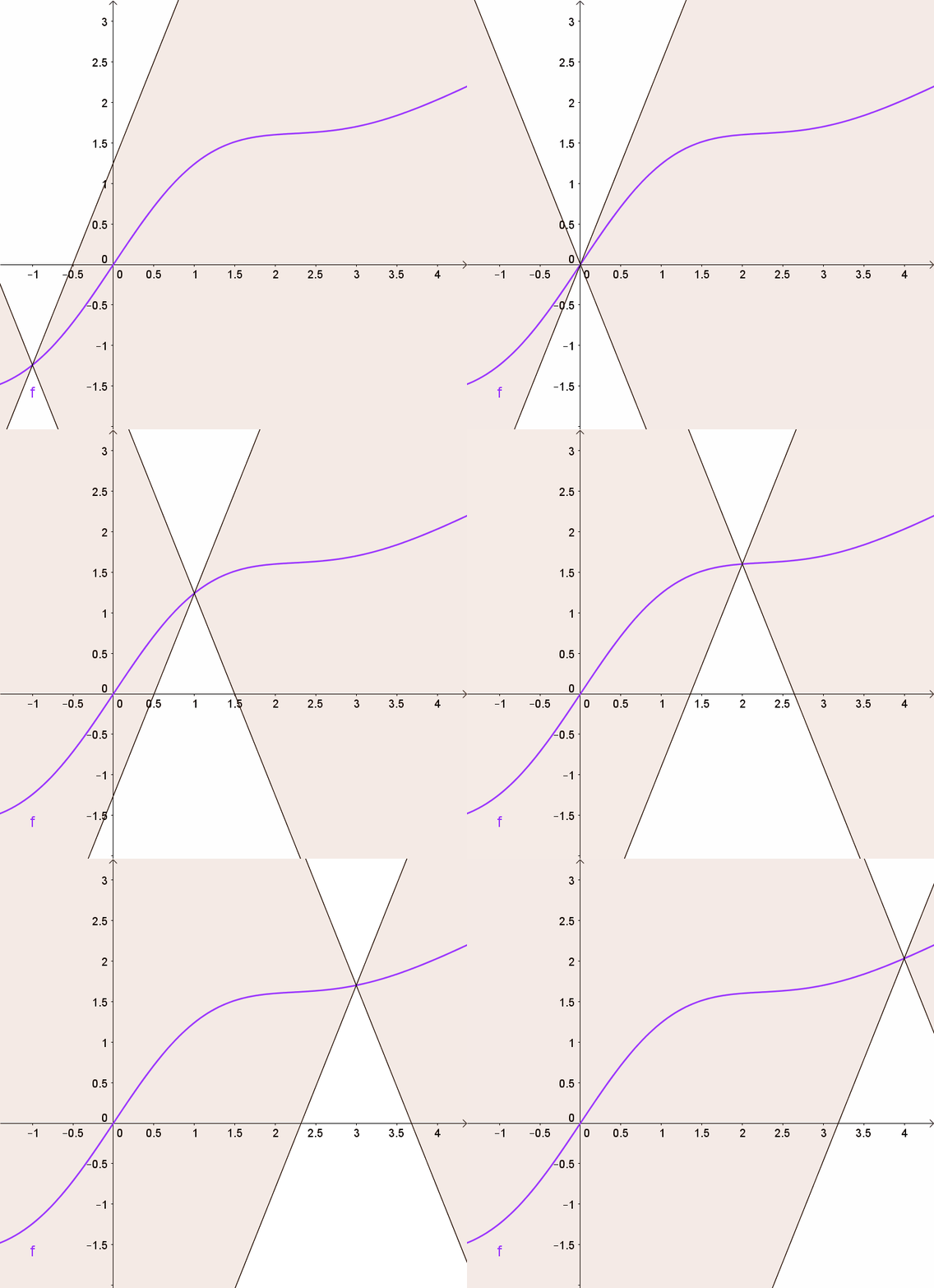
For a Lipschitz continuous function, there exists a double cone (white) whose origin can be moved along the graph so that the whole graph always stays outside the double cone
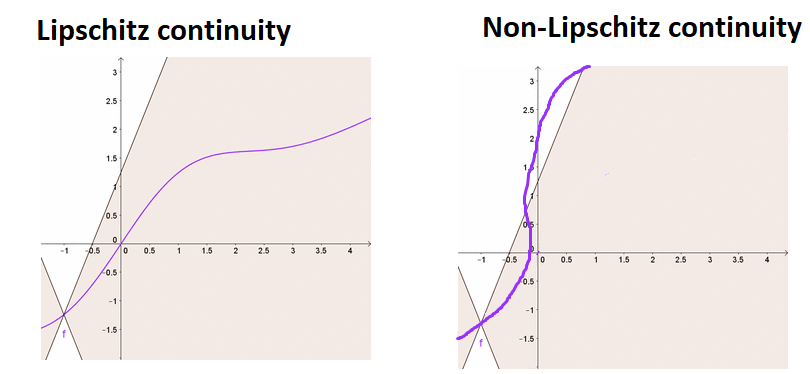
here the right function is growing very fast at some moment, that's why the graph is in the white double cone. Thus, it's not Lipschitz continuous.
Lipschitz Gradient
A differentiable function
This means that the gradient does not change too abruptly, ensuring stability in optimization algorithms like gradient descent.
- If a function has a Lipschitz gradient, it is smooth, but the reverse is not necessarily true — smooth functions are always differentiable, but Lipschitz functions may not be.
- Lipschitz continuity of the gradient ensures that second-order behavior (curvature) is well controlled.
Are
-
Lipschitz continuity of function values (Parameter
):
A functionis -Lipschitz if: This means that the function values do not change too rapidly — their difference is bounded by a linear factor of the distance between
and . -
Lipschitz continuity of gradient (Smoothness, Parameter
):
A differentiable functionis -smooth if: This means that the gradient does not change too abruptly, ensuring that the function's second-order behavior (curvature) remains controlled.
Key Difference:
(Lipschitz function values) controls how fast the function values can change. (Lipschitz gradient, i.e., smoothness) controls how fast the gradient can change.
Geometric Interpretation
- The Lipschitz condition means that the function's slope is bounded.
- If a function is
-Lipschitz, its graph lies within a cone of opening angle proportional to . - Unlike smooth functions, Lipschitz functions can have sharp corners, as long as their overall rate of change is bounded.
For example:
- The function
is Lipschitz but not smooth (it has a sharp corner at ). - The function
is both Lipschitz and smooth for a bounded domain.
Why Lipschitz Continuity Matters
-
Ensures Stability
- Functions that are Lipschitz-continuous do not change unpredictably, making them more robust in optimization and numerical computations.
-
Avoids Explosive Growth
- In real-world applications, unbounded growth in functions can lead to instability — Lipschitz continuity prevents this by capping the function’s rate of change.
-
Guarantees Convergence in Optimization
- Many optimization algorithms rely on Lipschitz continuity to guarantee bounded step sizes and convergence to optimal solutions.
Summary
| Property | Meaning |
|---|---|
| Lipschitz function | A function whose rate of change is bounded by |
| Lipschitz continuity condition | |
| Lipschitz gradient | |
| Lipschitz vs Smoothness | Every smooth function has a Lipschitz gradient, but not every Lipschitz function is smooth. |
| Applications | Used in stability analysis, optimization, and numerical computations. |
Lipschitz functions prevent extreme fluctuations, ensuring that small input changes lead to controlled output changes. This property makes them essential in both theoretical mathematics and applied fields like machine learning and signal processing. 🚀
See more...
Finding the Lipschitz Constant of a Function
Subgradients are could be bounded by the Lipschitz constant!