Dependency Types
What is Dependency Types?
In object-oriented programming (OOP), dependency types define relationships between different classes in a system. These relationships determine how objects interact and depend on each other to achieve functionality.
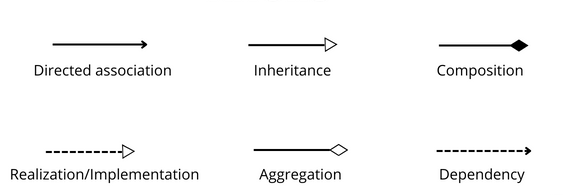
Types of Dependencies
The main types of dependencies in OOP include:
- Association
- Aggregation
- Composition
- Dependency
- Inheritance
- Interface Implementation
Association
Definition:
Association represents a "has-a" relationship between two classes, indicating that one class is related to another in some way.
In other words, it shows how classes are connected and interact with each other.
Association can be further classified into two types: Unidirectional and Bidirectional.
Unidirectional Association:
One class depends on another, but the reverse is not true.
Example: A Library class can lend books to a Student class. The student knows the library, but the library does not know the student.
class Library
{
    public void BorrowBook(string bookName)
    {
        Console.WriteLine($"Book '{bookName}' borrowed.");
    }
}

class Student
{
    public string Name { get; set; }

    public void BorrowBookFromLibrary(Library library, string bookName)
    {
        Console.WriteLine($"{Name} borrows book '{bookName}' from the library.");
        library.BorrowBook(bookName);
    }
}

Student student = new Student { Name = "Alice" };
Library library = new Library();
student.BorrowBookFromLibrary(library, "Introduction to C#");
// Output: Alice borrows book 'Introduction to C#' from the library.
//         Book 'Introduction to C#' borrowed.
// So, the student knows the library, but the library does not know the student.
In UML, it is represented by a solid line with an arrow pointing to the class that is being referenced.
Bidirectional Association:
Both classes are aware of each other and can interact mutually.
Example: A Teacher class knows their students, and students know their teacher.
class Teacher
{
    public List<Student> Students { get; set; }
}

class Student
{
    public Teacher MyTeacher { get; set; }
}

Teacher teacher = new Teacher();
Student student = new Student { MyTeacher = teacher };
teacher.Students = new List<Student> { student };
// Both classes are aware of each other.
In UML, it is represented by a solid line connecting the classes without arrows.
Metaphor:
Association can be thought of as a friendship where one or both parties know each other.
Aggregation
Definition:
Aggregation is a special type of association where one class is a collection or container of other classes, but the contained objects can exist independently.
Key Characteristics:
It represents a weak "has-a" relationship, meaning that the lifecycle of the contained objects is not dependent on the container.
Example: A Classroom contains multiple Students, but students can exist even if the classroom is deleted.
class Student
{
    public string Name { get; set; }
}

class Classroom
{
    public List<Student> Students { get; set; } = new List<Student>();
    // new List<Student>() initializes an empty list of students.
}

Classroom classroom = new Classroom();
Student student1 = new Student { Name = "Alice" };
Student student2 = new Student { Name = "Bob" };
classroom.Students.Add(student1);
classroom.Students.Add(student2);
Metaphor:
Aggregation is like a container and its contents — the container can hold items, but the items can exist independently.
Aggregation Characteristics
-
Independent Lifecycle:
The Student objects (student1andstudent2) can exist independently of the Classroom object. If the Classroom object is destroyed, the Student objects still exist. -
Ownership:
The Classroom object does not own the Student objects. It merely holds references to them.
Visual Representation
Imagine a classroom with students. The classroom can have many students, but the students do not cease to exist if the classroom is no longer there. They can move to another classroom or exist without being part of any classroom.
Composition
Definition:
Composition is a stronger form of aggregation where the contained objects cannot exist independently of the container. It's like a vice versa of aggregation.
Key Characteristics:
It represents a strong "owns-a" relationship, meaning that if the parent object is destroyed, the contained objects are also destroyed.
Example: A Car contains an Engine and Wheels. If the car is destroyed, the engine and wheels no longer exist.
class Engine
{
    public string Model { get; set; }
}

class Car
{
    private Engine engine;

    public Car()
    {
        engine = new Engine(); // Car cannot exist without an engine.
    }
    // if the car is destroyed, the engine is also destroyed.
}
Metaphor:
Composition is like a human body and its organs — if the body stops to exist, so do the organs.
-Engine engine means that the engine is a private member of the Car class, indicating
Dependency
Definition:
Dependency occurs when one class relies on another class for some functionality. This is often represented as a method parameter or local variable.
Key Characteristics:
Represents a "uses-a" relationship, meaning one class depends on another but does not own it.
Example: A PaymentProcessor class depends on a Logger class to log transactions.
class Logger
{
    public void Log(string message)
    {
        Console.WriteLine(message);
    }
}

class PaymentProcessor
{
    private Logger logger = new Logger(); // PaymentProcessor uses Logger.

    public void ProcessPayment()
    {
        logger.Log("Payment processed."); // here is the dependency
    }
}
Metaphor:
Dependency is like a chef using kitchen appliances — the chef depends on them to prepare meals, but they exist separately.
The diffirence between Composition and Dependency
Composition: This is a stronger relationship where one class owns an instance of another class. The composed class is responsible for the lifecycle of the instance it owns. This is often represented as a member variable.
Dependency: This occurs when a class relies on another class to perform a certain function. The dependent class does not own the instance of the other class; it simply uses it temporarily. This is often represented as a method parameter or a local variable.
// Dependency
public class Engine
{
    public void Start() { /*...*/ }
}

public class Car
{
    // we pass the Engine instance as a parameter
    public void StartCar(Engine engine)
    {
        // we use the Engine instance
        engine.Start();
    }
}
In this example, Car has a dependency on Engine because it uses an Engine instance passed as a parameter to the StartCar method.
// Composition
public class Engine
{
    public void Start() { /*...*/ }
}

public class Car
{
    private Engine _engine;

    public Car()
    {
        // we create an instance of Engine within the Car class (`new` keyword!)
        _engine = new Engine();
    }

    public void StartCar()
    {
        _engine.Start();
    }
}
In this example, Car is composed of an Engine because it owns an instance of Engine and is responsible for its lifecycle.
Basically, the key difference is that in Composition, the class owns the instance of another class, while in Dependency, the class uses the instance of another class without owning it.
In Dependency, we DO NOT use the new keyword to create an instance of the class, but in Composition, we do.
So, in Dependency, we use a reference to the instance of the class, while in Composition, we use the instance itself.
Inheritance
Definition:
Inheritance is a dependency type where one class (child) derives from another class (parent), inheriting its properties and behavior.
Key Characteristics:
Enables code reuse and establishes an "is-a" relationship.
Example: A Car class can inherit from a Vehicle class, gaining common attributes such as speed and fuel.
class Vehicle
{
    public int Speed { get; set; }
}

class Car : Vehicle
{
    public string Model { get; set; }
}
Metaphor:
Inheritance is like a child inheriting traits from their parents, sharing common characteristics while having unique ones.
Interface Implementation
Definition:
An interface defines a contract that a class must follow, ensuring it implements specific methods. In C++, this is similar to pure virtual functions or abstract classes.
Abstract classes (interfaces) define the "what" (method signatures), and concrete classes define the "how" (method implementations). The abstract class (interface) CANNOT exist on its own; it needs concrete classes to implement it.
Key Characteristics:
Promotes code decoupling, allowing different classes to implement the same behavior differently.
Example: A Dog and Cat class can implement the same IAnimal interface but provide different implementations.
interface IAnimal
{
    void Speak();
}

class Dog : IAnimal
{
    public void Speak() => Console.WriteLine("Bark");
}

class Cat : IAnimal
{
    public void Speak() => Console.WriteLine("Meow");
}

IAnimal animal = new IAanimal(); // Error: Cannot create an instance of an interface.
IAnimal dog = new Dog(); // OK
dog.Speak(); // Output: Bark
Metaphor:
Interfaces are like job contracts — different people (classes) follow the same contract but perform tasks in their own way.