Paths, cycles


Paths

A path Pn is a type of graph where the vertices can be arranged in a sequence v1,v2,,vn so that the edges link each consecutive pair vivi+1.

A simple path has no repeated vertices or edges, forming a linear chain through the graph.

Paths are fundamental for measuring distances and connectivity because the number of edges in a shortest path gives the distance between two vertices.

In applications such as routing and network flow, identifying paths enables algorithms to find efficient routes through complex graphs.

path Graphs.png|400
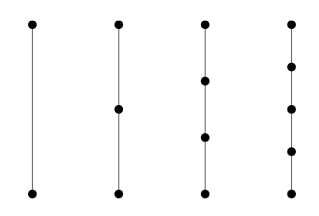
Figure 1. Path graphs with 2, 3, 4, and 5 vertices.

Example
A path P4 with vertices v1,v2,v3,v4 has edges v1v2,v2v3,v3v4.

Metaphor
A path is like stepping stones laid in a row across a stream, each stone connected directly to the next.

Cycles

A cycle Cn (or n-cycle) is a graph whose vertices v1,v2,,vn form a closed loop with edges v1v2,v2v3,,vn1vn,vnv1.

When n is even, we call Cn an even cycle. When n is odd, we call Cn an odd cycle.

Cycles detect loops within a graph and are key to understanding structures such as feedback circuits or non-acyclic dependencies.

In chemistry and biology, cycles model ring molecules or closed metabolic pathways, revealing circular interactions.

Cycle graphs Cn with n∈{3,4,5,6} vertices.png|600
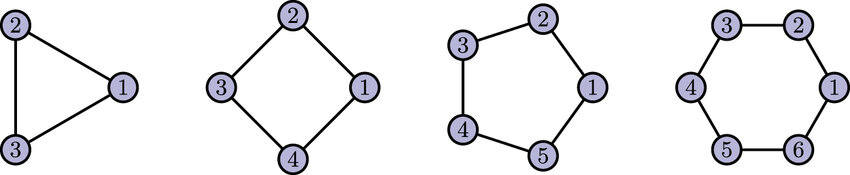
Figure 2. Cycle graphs with n{3,4,5,6} vertices.

Example
A cycle C3 with vertices v1,v2,v3 has edges v1v2,v2v3,v3v1 and forms a triangle.

Metaphor
A cycle is like a roundabout where each exit leads to the next until you return to where you started.

Connectivity via Paths and Cycles

A graph G is said to have a cycle if there exists a subgraph of G isomorphic to some cycle Ck.

Two vertices u and v in G are connected if there is a subgraph of G isomorphic to a path Pk with first vertex u and last vertex v.

Connectivity via paths defines whether information or flow can traverse the graph from one point to another.

The presence or absence of cycles differentiates acyclic structures like trees from more complex networks with loops.

Example
In a tree graph, any two vertices are connected by exactly one path and there are no cycles.

Metaphor
Connectivity in a graph is like a road network where towns are vertices and roads are edges; paths are routes, and cycles are loops you can drive around.

Conclusion

We have defined two fundamental structures in graph theory: the linear path Pn and the closed cycle Cn, each characterized by specific sequences of vertices and edges.

Paths serve as the building blocks for measuring distance and ensuring connectivity between vertices, while cycles reveal loops that distinguish acyclic trees from more intricate networks.

Understanding how paths and cycles embed into a graph via subgraph isomorphism underpins key concepts of connectivity and network structure analysis.