Regularity
Definition of a
A
This uniformity means each vertex participates in exactly
Many standard families of graphs are
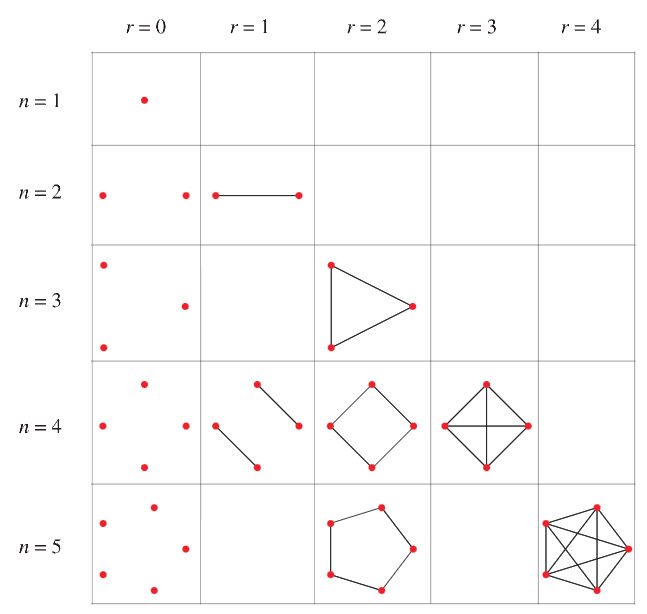
The complete graph
Imagine a roundtable where each of
A
Such graphs consist of
These graphs are trivial in connectivity and have no nontrivial structure or paths, making them a base case in many graph-theoretic arguments.
An empty graph with 4 vertices has no edges and is
It’s like a party where everyone arrives but nobody talks to anyone else.
A
This forces the graph to decompose into disjoint edges, forming a perfect matching on the vertex set. Such a graph can exist only when the number of vertices
These graphs are fundamental in matching theory and serve as the simplest nontrivial regular graphs beyond the empty case.
On 6 vertices, pairing them into 3 disjoint edges yields a
Think of couples at a dance where each person has exactly one partner.
Finite
A
Every connected component of a finite
These graphs appear in routing problems and circular arrangements, where each node has exactly two neighbors.
A union of a 4-cycle and a 5-cycle on 9 vertices is
Imagine multiple circular necklaces, each bead linked to two neighbors.
Size of an
The
Solving yields
This formula requires
A
Counting half the total handshakes when everyone shakes hands
Corollary: Odd
If
This corollary restricts the possible sizes of cubic (
A
You need an even number of dancers if each dancer pairs off an odd number of times.
A central open question asks whether every cubic graph can be decomposed into a disjoint union of a
This decomposition relates to edge-coloring theorems and factorization in regular graphs, and remains an area of active research.
The Petersen graph is a
It’s like trying to split a sturdy three-legged stool into one-leg and two-leg pieces that still stand.
Conclusion
We defined
The parity corollary shows odd
Finally, we highlighted the complexity of cubic graphs and the intriguing decomposition problem connecting matchings and cycles.