Existence of a Minimum
Understanding when a function reaches a minimum at a given point is crucial in optimization. These conditions are divided into necessary and sufficient conditions, classified based on the first-order and second-order derivatives of the function.
First-Order Necessary Condition (FONC)
If a function
for any feasible (possible) direction
Special Case: Interior Minimum
If
This means that at a local minimum in an unconstrained setting, the gradient must be zero.
Second-Order Necessary Condition (SONC)
If
- The first-order condition holds:
- The Hessian (second derivative test) must be positive semidefinite:
where
Special Case: Interior Minimum
If
- The gradient must be zero:
- The Hessian must be positive semidefinite:
This means the function curves upward or remains flat in all directions at
Second-Order Sufficient Condition (SOSC). Interior Case
For
- Gradient is zero:
- Hessian is positive definite:
This ensures that the function strictly curves upwards, confirming
Examples and Counterexamples
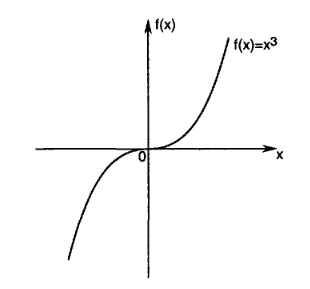
Satisfies FONC and SONC, but is not a minimum!
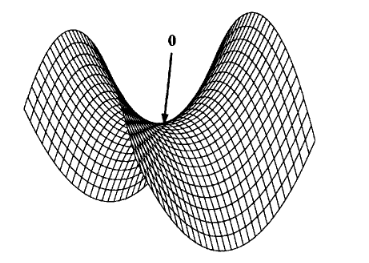
Satisfies FONC but not SONC, meaning
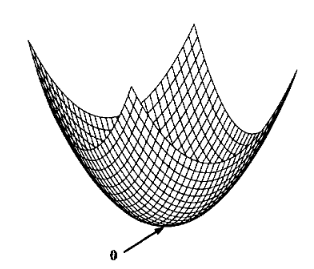
Satisfies FONC and SOSC, making
Summary
| Condition | Formula | Interpretation |
|---|---|---|
| FONC (First-order necessary) | Ensures no descent direction at |
|
| SONC (Second-order necessary) | Ensures function is not curving downward. | |
| SOSC (Second-order sufficient) | Ensures strict local minimum. |
These conditions form the foundation of optimization theory, guiding both theoretical analysis and practical algorithms. 🚀